

Training Programs
Certification-prep training built for every level your agency needs to train — EMT, AEMT, and Paramedic. Each program includes structured training content, practice quizzes, and a practice exam. NTCP does not issue NREMT or state certification itself — see our Terms for what a license does and doesn't include.
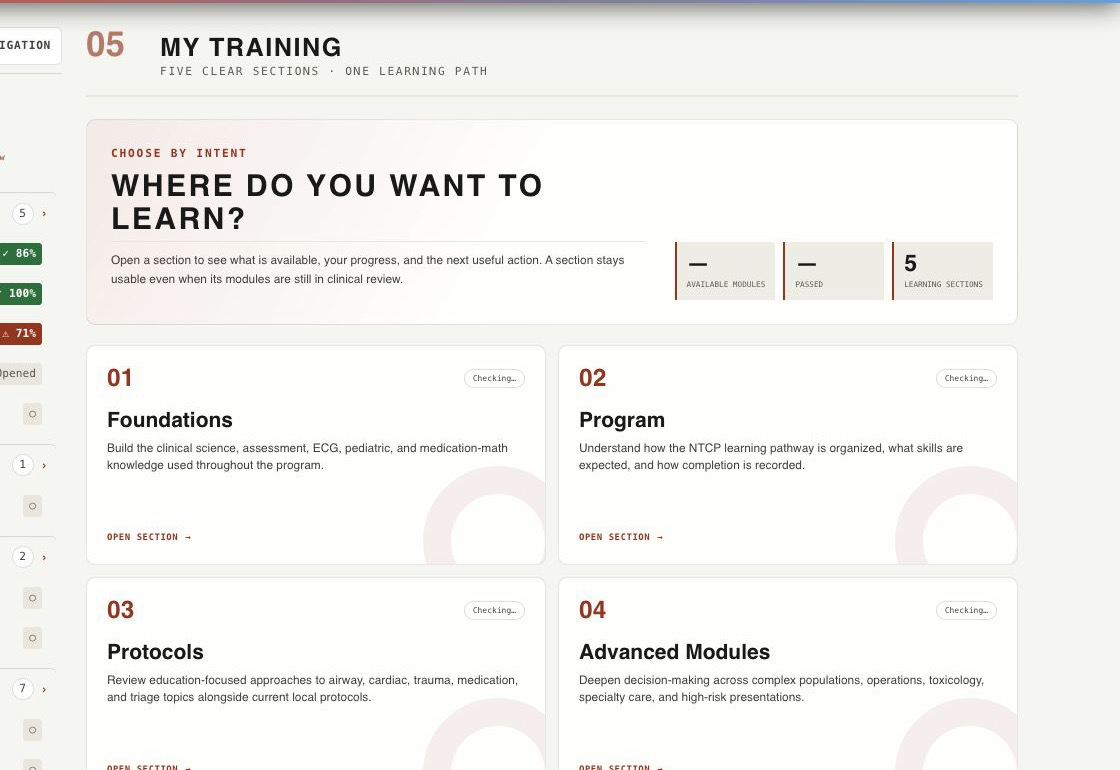
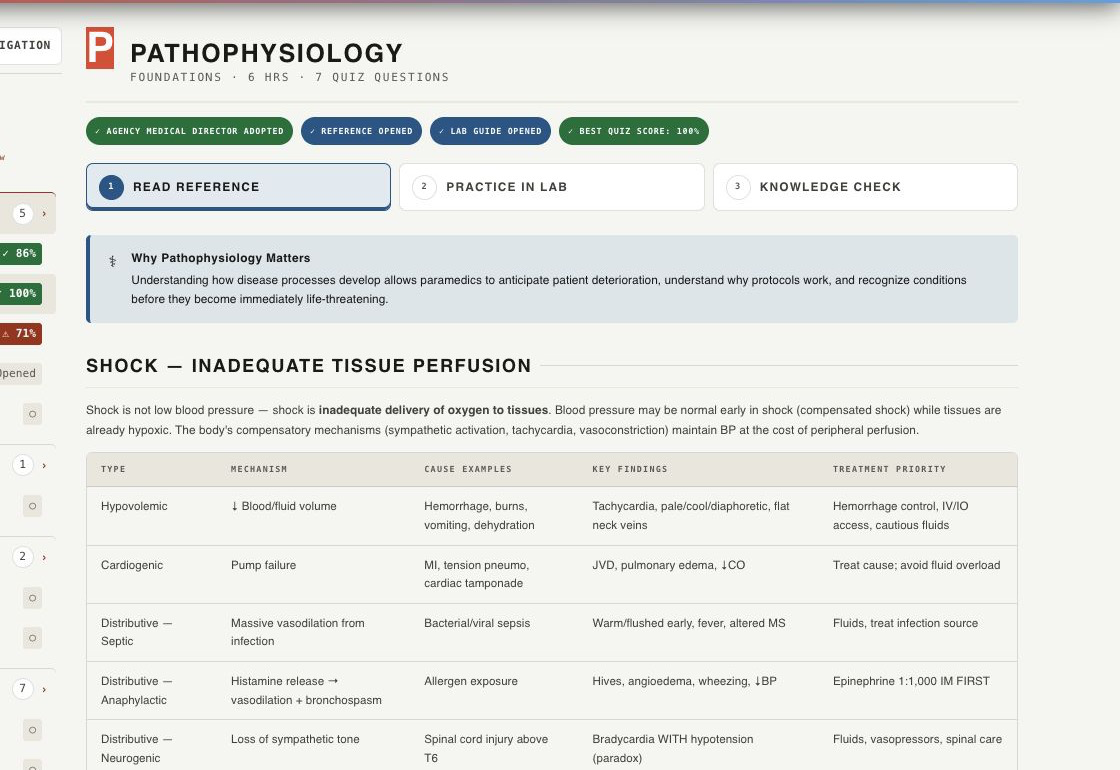
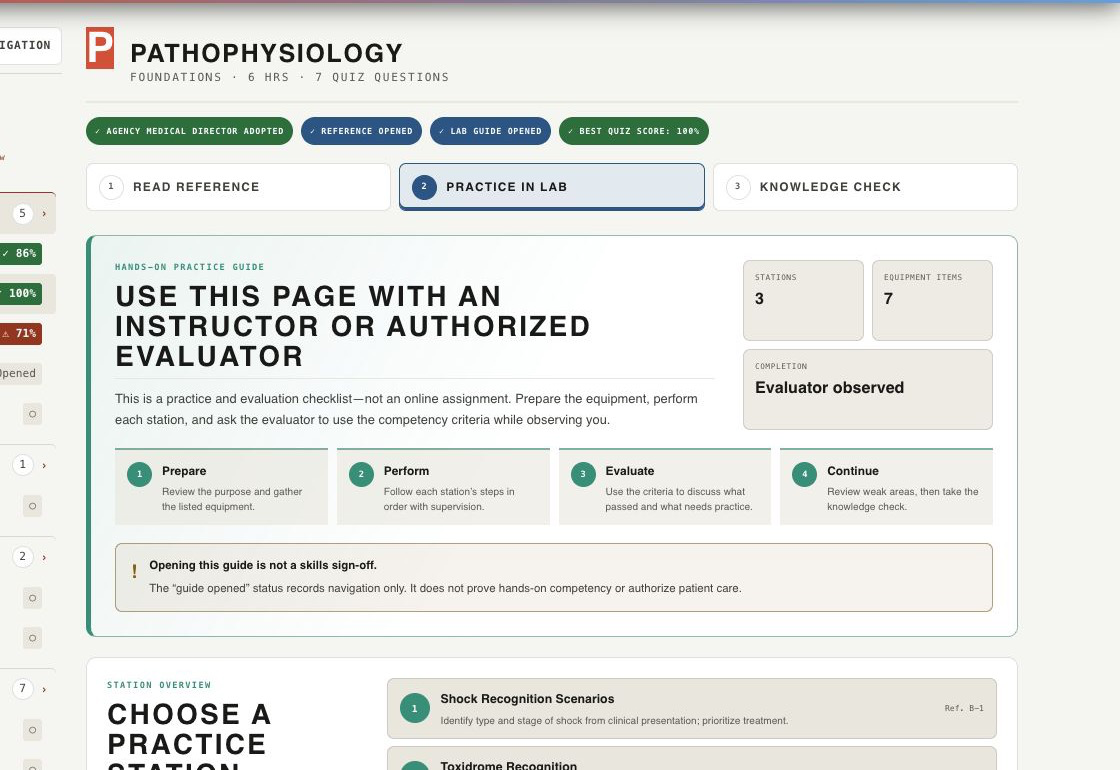
Five intent-based sections lead to the modules currently available to that student.
Current release-candidate UI · synthetic demonstration data
Three certification levels, one platform
Most agencies train at more than one level at once — new-hire EMTs, AEMTs bridging toward advanced scope, and paramedics carrying full ALS responsibility. NTCP treats each as its own dedicated program rather than one generic course with a level filter, because the clinical scope, the quiz content, and the reference material at each level are genuinely different.
EMT — the foundation
EMT Certification-Prep Training covers the core EMS competency domains most new hires and career-starters need ahead of an EMT certification exam — airway and breathing, circulation and shock, trauma assessment, medical emergencies, and BLS operations. It's the level most agencies license first, whether for new-hire onboarding or as a structured refresher.
AEMT — the bridge
AEMT Certification-Prep Training builds on EMT-level material with the additional assessment and intervention scope AEMTs are trained for, including IV therapy, expanded medications, and advanced airway adjuncts. It's built for agencies moving personnel from Basic to Advanced Life Support responsibilities.
Paramedic — full scope
Paramedic Certification-Prep Training is the deepest program on the platform: full ALS-level training content, a protocols reference for on-shift lookup, and the same practice-quiz and practice-exam structure as the other two levels, scaled to paramedic scope.
All three programs are licensed the same way — through your agency, not to individual students — see how seats map to your organization on Pricing.
EMT Certification-Prep Training
Foundational EMT-level training content, quizzes, and a practice exam.
Learn more →AEMT Certification-Prep Training
Advanced EMT-level training content and assessments.
Learn more →Paramedic Certification-Prep Training
Full paramedic-level training content, protocols reference, and practice exam.
Learn more →Same structure at every level
Regardless of which program a seat is licensed for, every module follows the same three-part structure: a Reference section for reading, a Lab Guide for the hands-on skill-station side (equipment checklists and skill-station competency criteria that pair with a real skills lab — the platform prepares students for lab practice, it doesn't replace it), and a Quiz that has to be passed to mark the module complete. That consistency means a training officer who understands how one program is graded and reported already understands how all three work.
Four governed roles, one agency license
Licensing seats for these programs plugs into the same platform used for everything else on NTCP. An Owner-level account (used by the NTCP team) manages the platform itself; your organization's Agency Admin account is the one your training officers actually use day to day — inviting personnel, assigning each one to an EMT, AEMT, or Paramedic seat, and reviewing progress and quiz performance across the team. An agency-scoped Medical Director reviews exact clinical content and local overlays when required, and each invited person gets a Student workspace for training content, quizzes, practice assessments, and their CME log. These responsibilities use the same governed records without giving every role the same power.
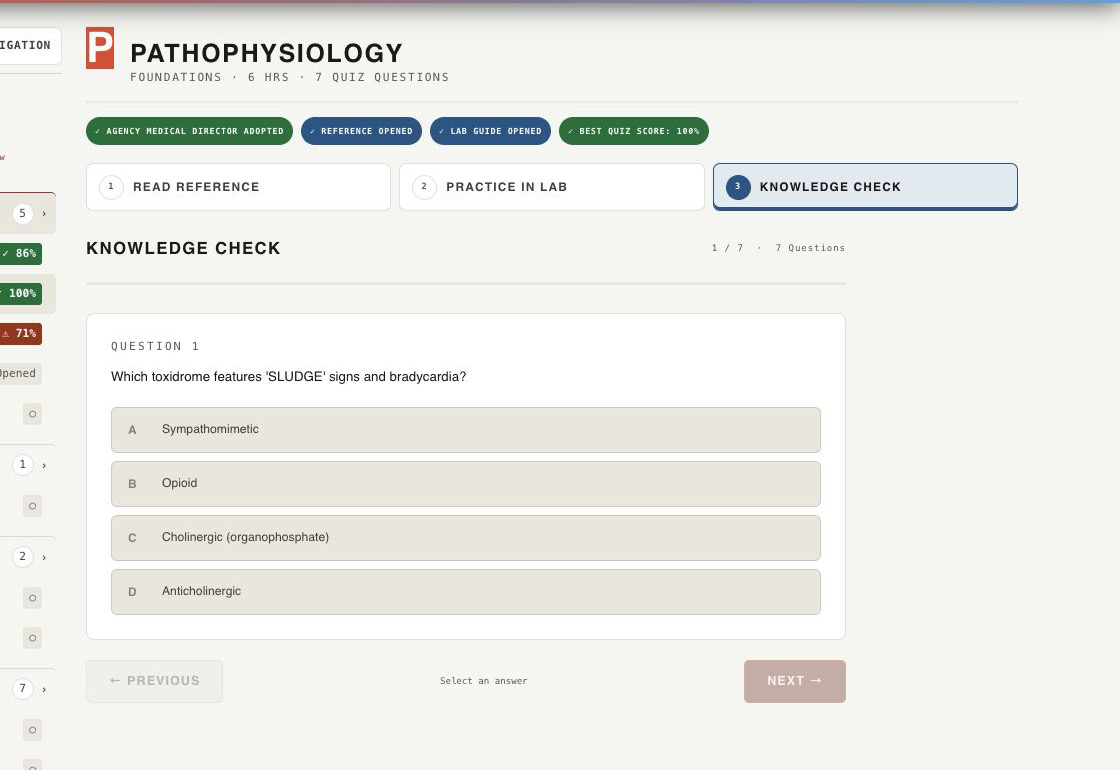
See a real quiz question
Every module quiz works exactly like this — one locked-in answer, immediate feedback, inline explanation.
How the training actually works
Pass threshold on every module quiz and the full practice exam
Content types per module: Reference, Lab Guide, and Quiz
Questions reshuffled per attempt, so retakes aren't just memorization
Critical-knowledge questions flagged and tracked separately in agency reporting
Beyond initial certification
Passing the certification exam is a beginning, not an end point, for most EMS careers. NTCP's three programs connect to the rest of the platform for what comes after: Recertification Training for EMT and paramedic renewal cycles, a CME log for continuing education hours (self-reported today — it isn't yet CAPCE-accredited, and we say so plainly rather than implying otherwise), the Full Practice Exam for configurable 20/40/80-question exam-style practice scored server-side, with no claim that it reproduces or predicts an official exam, and the Drug Label Lookup, a one-drug label reference that uses RxNav (NLM) and openFDA drug-label data rather than a static reference table, for on-shift and study use alongside the AEMT and Paramedic programs.
Who licenses these programs
NTCP seats are licensed to the EMS agency, not sold to individual students — your agency's administrator invites personnel and assigns each one to whichever program matches their role, so there's no separate signup flow to manage per person. That model fits fire departments, EMS services, hospital-based EMS programs, and training programs alike — see how the specifics apply to your organization on those pages, or read Agency Training Management for what an agency administrator sees once seats are active.
Getting started
Two seat tiers cover most agencies today: 5 seats at $999/year and 10 seats at $1,799/year — see Pricing for full details. Licensing gives your agency administrator their own dashboard to invite personnel, assign seats across the EMT, AEMT, and Paramedic programs as needed, and track progress; each invited student gets their own dashboard once added. There's no self-service purchase path for individuals — sign up your agency to get started, or reach out via Contact with questions first.
Frequently asked questions
What's the difference between the EMT, AEMT, and Paramedic programs?
Each is a dedicated program built around that level's clinical scope, not one shared question bank filtered by a tag. EMT covers foundational BLS competencies, AEMT adds the assessment and intervention scope AEMTs are trained for, and Paramedic covers full ALS scope with its own protocols reference. All three follow the same Reference / Lab Guide / Quiz structure and the same 75% pass threshold, so the experience is consistent even though the clinical content isn't shared across levels.
How does an agency actually get set up on NTCP?
Your agency licenses seats (see Pricing), which creates an Agency Admin account for your organization. That administrator invites your own personnel and assigns each one to whichever program — EMT, AEMT, or Paramedic — matches their role. There's no individual signup path; access always starts with an agency license.
What's the pass threshold on module quizzes?
75% — the same threshold used consistently across module quizzes and the full practice exam, so students always know exactly where they stand.
Are quiz questions the same every time?
Question order is shuffled per attempt so retaking a quiz isn't just memorizing answer positions — the same question set is reshuffled, not swapped for different questions.
What happens after I answer a question?
Each question locks in after one answer — correct/incorrect is revealed immediately with color coding, plus an inline explanation, before moving to the next question. This mirrors real NREMT-style exam feedback rather than a delayed end-of-quiz reveal.
What does "Critical Knowledge" mean on a question?
Some questions are flagged as covering critical, high-stakes knowledge (e.g. airway, cardiac arrest management). Agencies can see critical-question performance separately in their analytics — a missed critical question is treated as a more urgent training gap than a missed general-knowledge question.
Is there a Lab Guide alongside the online training?
Yes — each module pairs its Reference content with a Lab Guide (equipment checklists and skill-station competency criteria) for the hands-on side of training. The platform prepares students for lab practice, it doesn't replace it.
Does clinical/protocol content get reviewed by a Medical Director?
That's the goal, and it's an explicit, tracked status on the platform (not assumed) — see our Medical & Clinical Content Disclaimer for exactly what's been reviewed as of today.
Ready to bring your agency's training in-house?
Request access and we'll follow up to get your department set up.
Sign up your agencyStudent learning walkthrough
A learning path that explains what comes next.
The student experience moves from intent-based browsing to governed reference material, supervised practice, and an internal knowledge check.
Explore training programsRelease-candidate workflow shown with synthetic examples. Availability depends on role, agency access, exact-version review, and local adoption.
- 01
Start by learning intent
Browse Foundations, Program, Protocols, Advanced Modules, or Certification Programs and see what is currently available.
- 02
Check the exact version
The reference view keeps the education-only boundary and the current platform and agency approval state visible.
- 03
Use plain-language lab stations
Preparation, procedure, evaluation criteria, common mistakes, and what to do next stay in one supervised workflow.
- 04
Review understanding
Answer choices are consistent, explanations are immediate, and results remain internal learning records—not certification.