


CME Tracking
A self-reported continuing-education log built into every seat, with roster-wide visibility for your agency's training officers — so recert deadlines show up as a dashboard, not a surprise.
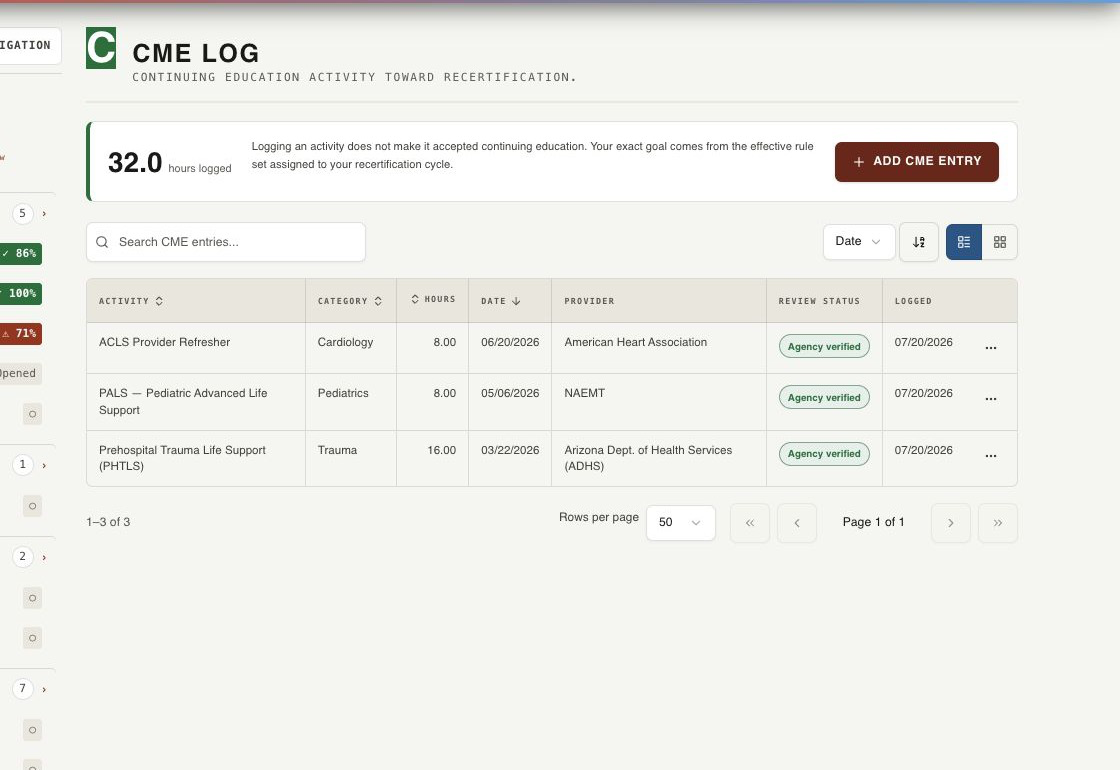
Logging, agency evidence review, and external acceptance remain separate states.
Current release-candidate UI · synthetic demonstration data
Accreditation status — read this before you rely on it
NTCP is not currently a CAPCE-accredited CE provider. A log entry begins as a student claim; an agency reviewer may record an internal evidence decision, component, and verified-hour amount, but that does not accredit the activity or prove that an external authority accepted it. Whether the education satisfies your state's recertification requirement is between your agency and your state EMS office; see our explainer on what CAPCE accreditation actually is and our state requirements reference and verify independently before anyone treats a logged hour as satisfied. This is a tracking and compliance tool for your agency, not an accrediting body, and we'd rather say that plainly up front than have it surface as a surprise at renewal time.
What's actually in the log
Every entry is student-entered: activity, category, provider, hours, date, and an optional evidence reference. Nothing is auto-generated from a certificate scan or third-party feed. Saving creates a logged claim; it does not make the activity accepted credit. For students on a configured recertification enrollment, the agency receives a review queue and must record evidence, notes, rule component, and verified hours before progress changes. For the broader distinction between CME and CE terminology and how states use each, see our CME / CE resource page.
Logging an entry
- Enter the external activity and category
- Record its provider, hours, and occurrence date
- Add a certificate or other evidence reference when available
- Save it as logged evidence for separate agency review
The agency can verify or reject the entry within an assigned cycle. Verification is an internal evidence classification—not an NREMT, state, or accreditor decision—and cannot exceed the logged hours. Evidence-reviewed external education is the only activity that advances the rule-component progress shown to the student.
The exact rule version ties it together
An agency assigns an effective, source-linked rule version to the student's exact cycle, certification level, pathway, and jurisdiction. The current national 2025 NCCP totals are EMR 16, EMT 40, AEMT 50, and Paramedic 60 credits, with component-specific requirements; state rules may add or alter obligations. The tracker counts only agency-verified external education within the cycle and caps each component independently. If no matching rule is configured, it says requirements are not configured instead of displaying a percentage.
Recertification-deadline tracking for training officers
For agencies, the payoff isn't the individual log — it's the roster view. Training officers and administrators can see every seat's logged hours and upcoming recert deadlines in one dashboard, with people coming due flagged before it turns into a last-minute scramble. Instead of chasing down spreadsheets or emailing each provider individually, an agency admin opens one screen and sees who's on track, who's behind, and who needs a reminder this month. See how this rolls up alongside the rest of an agency's training oversight on Agency Training Management.
CME compliance vs. Medical Director sign-off — two separate records
It's worth being precise about what CME tracking is not. A student's CME/recert progress — evidence-reviewed external education under an assigned rule — is separate from Medical Director sign-off, which is a distinct, agency-level clinical-authorization record (reviewer name, title, state, review dates) required before clinical content is treated as field guidance. A student can be fully caught up on CME while their agency's MD sign-off on the underlying training content is still pending, or vice versa. NTCP keeps these as two independent tracks rather than folding one into the other, because they answer different questions: one is "is this person current," the other is "has a licensed clinician reviewed what they were taught."
Who this is for
CME tracking ships as part of every licensed seat, so it's relevant wherever NTCP is deployed — fire departments, EMS services, hospital-based EMS programs, and training programs all get the same roster-wide view, scaled to however many seats they've licensed. There's no separate CME-only tier or add-on — it's built into the Agency Admin and Student dashboards from day one, alongside certification-prep training and recertification training. Licensing is per agency, sized by seat count rather than by feature — see current tiers on Pricing — so a training officer isn't choosing between "the plan with CME tracking" and "the plan without it." Every seat gets the same dashboard.
Where it fits with the rest of the platform
CME tracking is one piece of a broader training record students and agencies build up over time. NTCP module completion remains visible learning history but does not flow into accepted-CE progress automatically; the same student can rehearse for an exam with the Full Practice Exam, or look up a drug interaction with the Drug Label Lookup, without any of that activity needing to be manually reconciled against their CME log — the platform keeps the training side and the CME side connected instead of treating them as separate systems a student has to keep in sync by hand.
A note on what this isn't
NTCP does not issue or guarantee NREMT or state certification — that determination always belongs to NREMT and your state EMS office. CME tracking here is a self-reported record your agency can see and manage, useful for internal compliance oversight and for a student building their own case at renewal time, but it is not a substitute for whatever documentation your state formally requires. When in doubt about what counts, current hour requirements, or renewal cycles, NREMT.gov and your state EMS office are the authoritative sources — our state requirements page is a starting point for orientation, not a replacement for checking directly.