


Full Practice Exam
A configurable cross-module practice assessment for identifying study gaps. It is not an official National Registry examination or a replica of its length, delivery model, technology-enhanced items, security, or scoring.
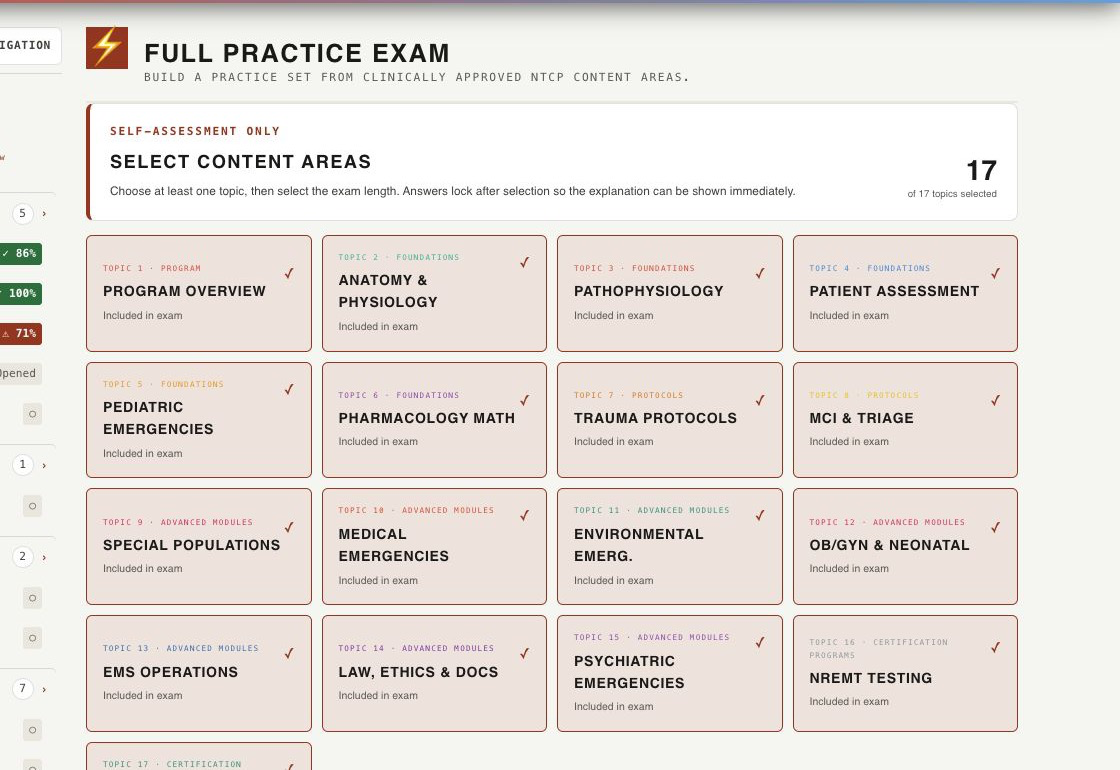
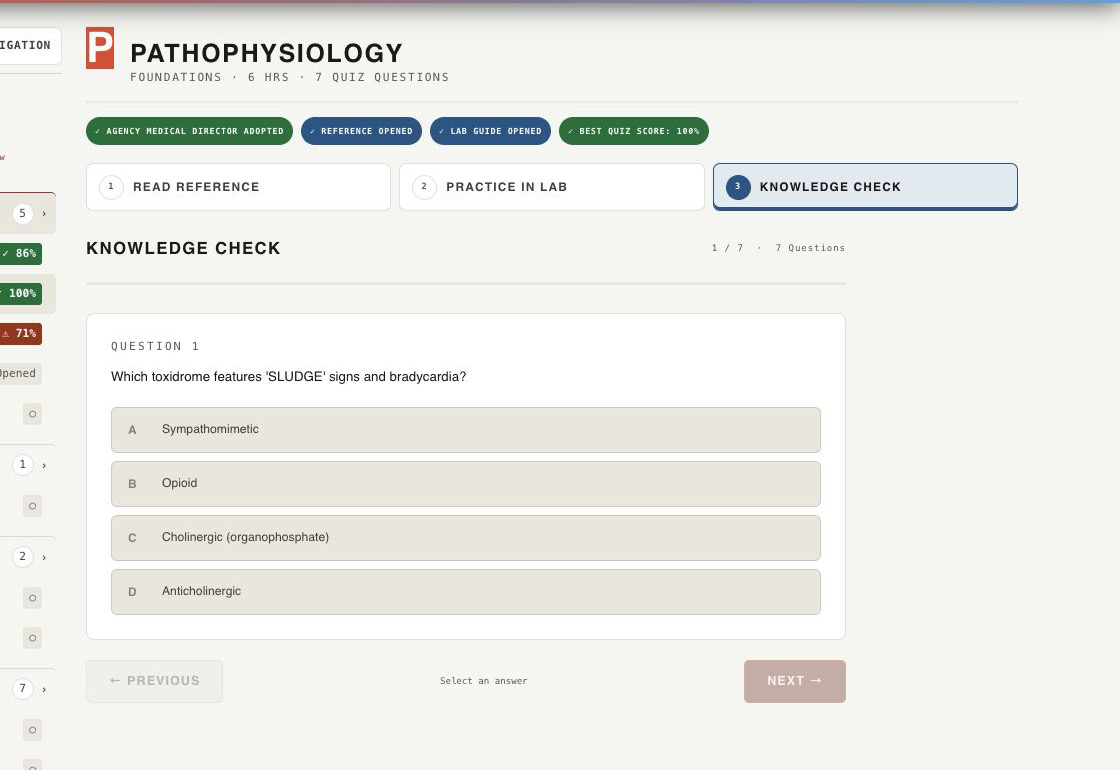
A configurable internal NTCP practice assessment—not an official exam, adaptive replica, or result predictor.
Current release-candidate UI · synthetic demonstration data
How it works
Choose from every published training module, or leave all selected for a broad cross-module practice set.
20, 40, or 80 questions — sized to however much time a student has.
One question at a time, options A–D, each locked in immediately after answering with color-coded feedback and an inline explanation.
Overall score against the 75% pass line, plus a per-content-area breakdown showing exactly which domains need more work.
Who it's for
Students use it as a low-stakes way to identify content that needs more review before an examination. A student a week out from a certification exam can run an 80-question cross-module practice set; a student with twenty minutes between shifts can run a 20-question spot-check on the one domain they're worried about. Training officers and agency admins get the other half of the value: a per-content-area signal for every student on the roster, not just a pass/fail list. That's useful whether you're running a fire department training division, an EMS service's field-readiness program, a hospital-based EMS unit, or a training program preparing students for their first attempt at the Registry exam.
What's actually covered
The exam doesn't ship with a fixed, hardcoded question bank sitting outside the curriculum — its content areas are drawn directly from whatever training modules your agency has published, across EMT, AEMT, and Paramedic certification-prep training and recertification training. As your agency adds or updates modules, the pool of content areas available at exam setup updates with it. That also means two agencies running NTCP can see slightly different content-area lists on the setup screen, because they've published different modules — the exam always reflects what's actually been taught, not a generic outside bank.
Why a breakdown by content area matters
A single overall score tells a student they need to study more — a content-area breakdown tells them what to study. That's the difference between a pass/fail gate and something a training officer can actually act on. The results screen lists content areas weakest-first, so the lowest score on the page is also the first thing a student sees — there's no scrolling past a strong overall number to find the one domain that's actually a problem. See how this rolls up agency-wide on Agency Training Management.
Choosing content areas in practice
Because the content-area list is just every published module an agency has live, it naturally splits along the same lines the rest of the platform does. A student working toward their first certification sees the cert-prep modules for their level — EMT, AEMT, or Paramedic — and can leave every one selected for a true cross-curriculum simulation, or narrow the list down to the one or two modules a training officer flagged after a prior attempt. This is not a National Registry test-plan domain blueprint. A paramedic coming up on recertification instead draws from the recert modules published for their agency, so the practice exam stays relevant to what they're actually being retrained on rather than mixing in first-certification content that no longer applies to them.
Multiple attempts, real progress tracking
A practice exam isn't a one-shot gate — a student can generate and submit as many attempts as they want, and every one is kept as its own record rather than overwriting the last. That history is what turns a single score into an actual trend: a student's attempt list, ordered most-recent-first, shows whether a weak content area from two weeks ago has actually improved or is still sitting at the same score. A single attempt answers "am I ready today"; the attempt history answers "am I getting there."
Server-side scoring and anti-cheat mechanics
Every practice-exam score is computed server-side from the real answer key — the client never gets to submit or influence a score directly, it only ever submits which option (A–D) the student picked for each question. The server holds the answer key and the pass threshold; the browser holds neither. That closes off the two easiest ways a browser-side exam gets gamed: editing a client-side score variable in dev tools, or reverse-engineering an answer key that was shipped to the browser in the first place.
The exact, randomized question set an attempt actually presented is persisted with that attempt — not regenerated or assumed afterward. That matters for two reasons. First, it means an attempt can be independently re-scored at any time from stored data and will always match the score the student originally saw — there's no path where the recorded result and the real answer key silently drift apart. Second, it's what makes the content-area breakdown trustworthy: the breakdown is computed from the questions that specific student actually answered, not from an average or an assumption about what a typical attempt covers.
Within an attempt, each question is answered and locked in immediately — the student sees color-coded feedback and the explanation for that question before moving to the next one, and can't go back and revise an earlier answer once it's submitted. Combined with server-side scoring, that means the number a student and their training officer see at the end is the same number the system would compute if you re-ran the check independently — there's no client-trusted step anywhere in the chain a score could be fabricated at.
Reviewing a completed attempt
After an exam, review mode walks back through every question with the student's answer, the correct answer, and the explanation — organized by the same content areas as the results screen, so a student moves straight from "here's my weak domain" to "here's exactly which questions in that domain I got wrong and why." That's a different job than a single module quiz, which checks understanding of one topic right after it's taught — the practice assessment is the cross-module review that can come later, closer to test day. Read more about how the two fit together on How It Works.
Not a National Registry examination or readiness prediction
A score reflects performance on the selected NTCP questions only. National Registry exam length, adaptive or linear delivery, item formats, security, and scoring differ by level; an NTCP result does not predict a pass or establish entry-level competency. NTCP does not issue or guarantee National Registry certification or state licensure. If you're unclear on how the two relate, our NREMT vs. State Certification guide walks through the distinction in full.
What training officers and agency admins see
On the agency side, practice-exam activity feeds the same read-only reporting used across the platform on Agency Training Management — per-student readiness broken out by content area, not just a raw pass/fail headcount, so a training officer can see who's not ready yet and in which domain before it becomes an exam-day surprise. It's built to inform that judgment call, not replace it.
Related tools
A full practice exam pairs naturally with two other tools on the platform: the Drug Label Lookup, for reading one medication's FDA label sections pharmacology data while studying a weak content area rather than relying on memory alone, and CME Tracking, for logging the study time once certified. And because every attempt is scored and stored, agencies with an active license can see exam activity roll up across their whole roster on Agency Training Management — see Pricing for how seats are licensed.