

NTCP for EMS Services
EMS services live and die by certification compliance across a full-time provider roster. NTCP gives your training officers one dashboard for the whole crew instead of a spreadsheet per provider.
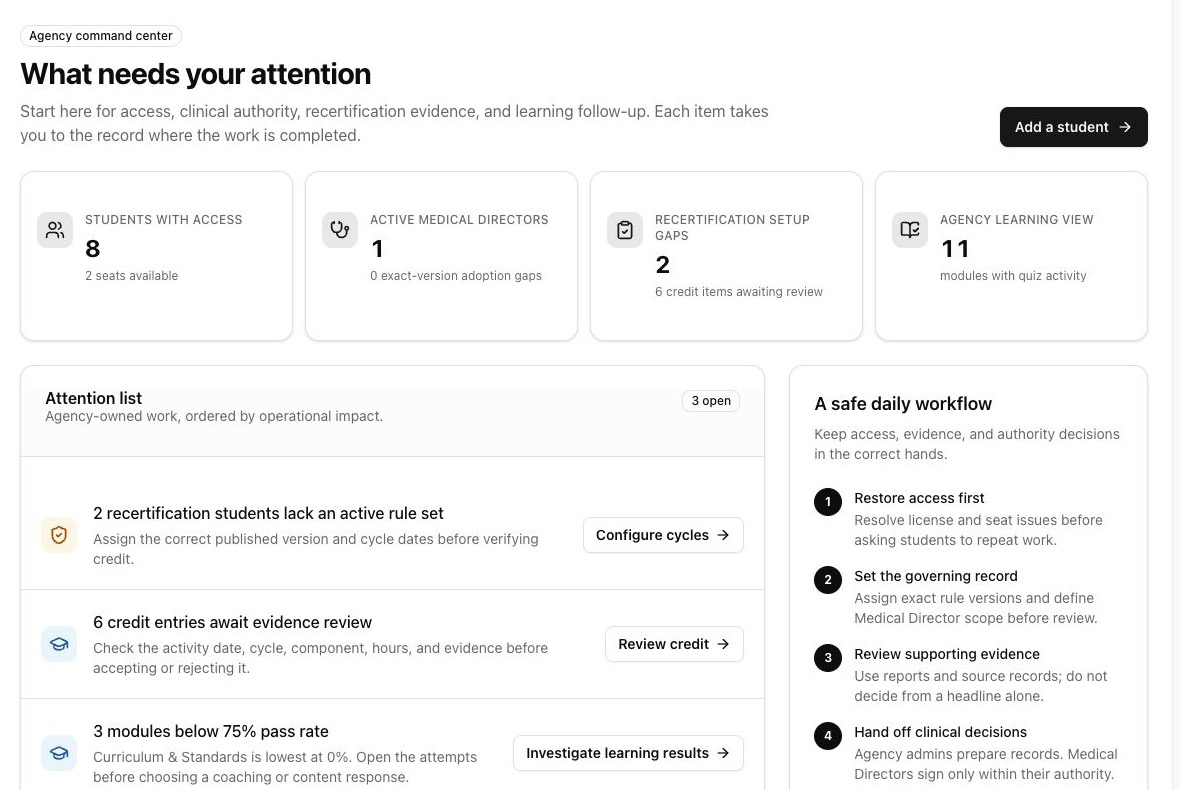
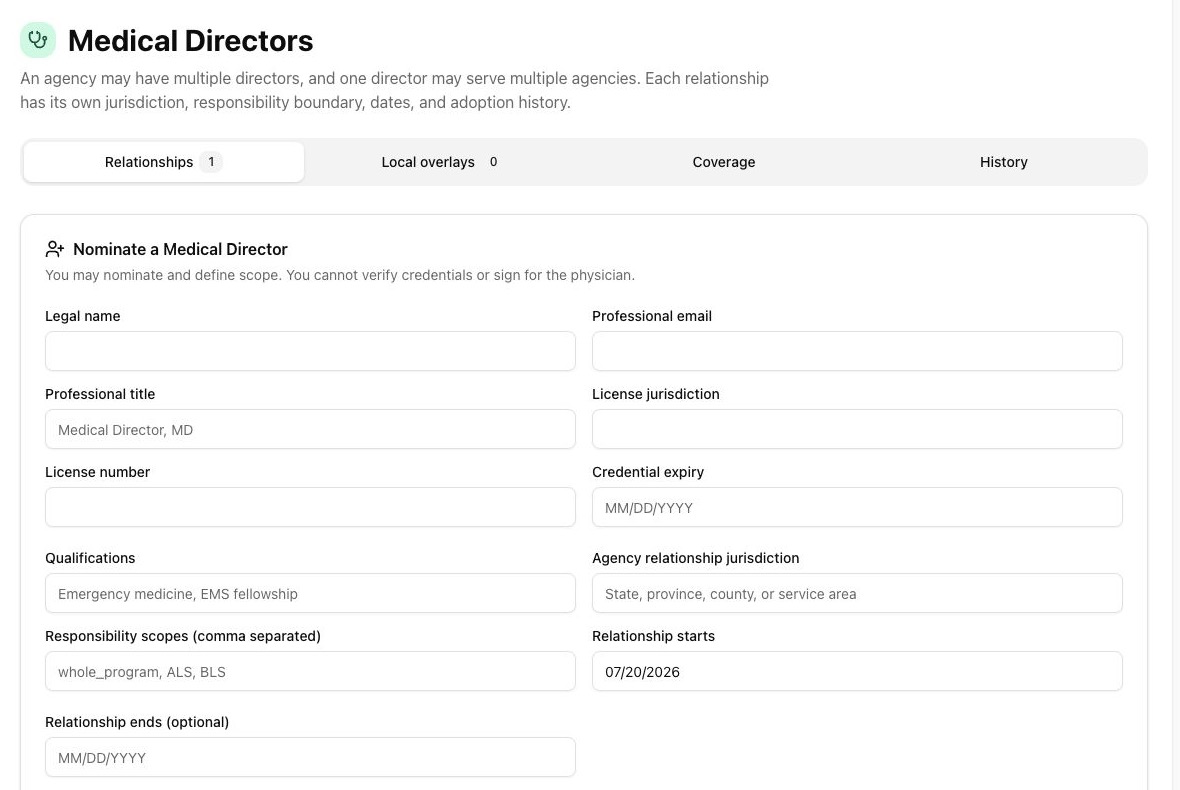
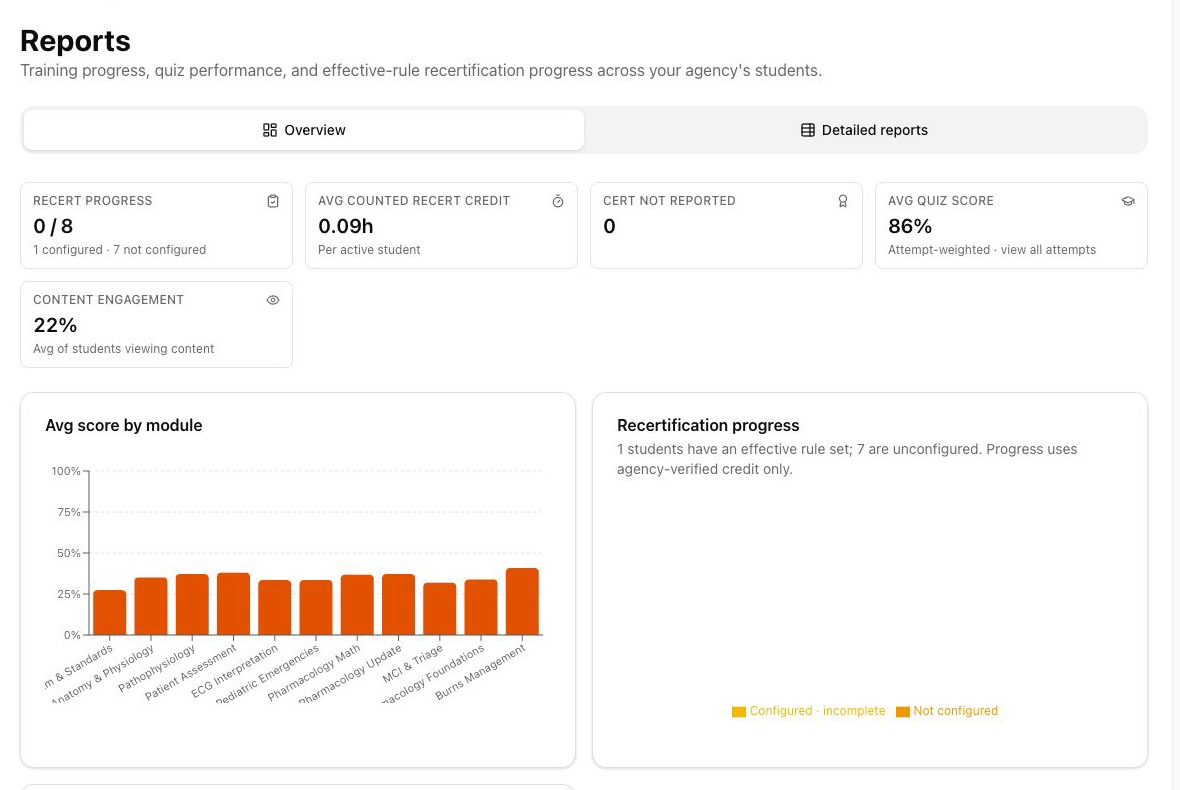
The agency dashboard starts with work that needs attention and links to the record where that work is completed.
Current release-candidate UI · synthetic demonstration data
Why EMS services use NTCP
- Roster-wide certification-level and recert-deadline tracking, EMT through Paramedic
- Self-reported CME log visible to your training officers, not buried in personal folders
- Seat-based licensing that scales as your service grows — reassign seats, don't repurchase
- Role-based access so Students, Agency Admins, Medical Directors, and platform Owners see the work they own
Crew certification management, built for a full-time roster
A career EMS service isn't training one class at a time — it's running EMT-Basics, AEMTs, and Paramedics side by side, on staggered recert cycles, often across multiple stations or shifts. A per-provider spreadsheet (or worse, a shared folder of PDFs) works until your roster passes a dozen people and then it just doesn't. NTCP's Agency Admin dashboard gives your training officer one screen for the whole crew: who's assigned to a Certificate Training track versus a Recertification track, where each person sits in their modules, and who's coming up on a renewal window. Seats aren't locked to a certification level, so a mixed EMT/AEMT/Paramedic roster runs under one agency license rather than separate purchases per level.
Four governed roles, one agency license
NTCP is organized around four roles rather than one generic login for everyone. The platform Owner manages NTCP policy, organizations, billing, content, and launch controls. The Agency Admin workspace is where your training officer manages the crew: inviting providers, assigning certification level and track, and watching module and quiz progress roster-wide. A separately authorized Medical Director reviews exact clinical versions and local overlays within the agency relationship's scope. TheStudent workspace shows each provider only their own modules, quiz history, CME log, and practice assessments. NTCP does not currently claim a production ePCR integration; confirm any required downstream export or regulatory-submission workflow.
Certification-prep and recertification, in one place
New hires and lateral transfers work through EMT, AEMT, and Paramedic certification-prep training before their first certification examination attempt; providers already certified stay current through recertification training built around the same module-and-quiz structure. Both run through the same agency license, so a training officer isn't juggling one system for onboarding and a different one for keeping veterans current — it's one roster, one dashboard, two tracks.
Field readiness: practice exams and live drug lookups
Two tools inside the platform are aimed specifically at keeping a working crew sharp between formal training cycles. The Full Practice Exam is a configurable 20-, 40-, or 80-question exam-style practice assessment, scored server-side with a per-content-area breakdown. It does not reproduce National Registry exam structure or predict a certification result; it is useful for a provider preparing for a recertification examination and for a training officer who wants a roster-wide read on where knowledge gaps actually sit, not just a pass/fail list. The Drug Label Lookup is a one-medication lookup built on RxNav (NLM) and openFDA drug-label data, not a static internal list — about twenty quick-select drugs with boxed-warning, interaction, and contraindication sections for study. It does not evaluate a drug pair or patient and does not replace current agency-approved references, a pharmacist, or Medical Direction.
CME logging, self-reported
Providers can log continuing education hours directly in their Student dashboard, visible to their Agency Admin instead of sitting in a personal folder no one else can see. This log begins with student-entered evidence. NTCP is not currently a CAPCE-accredited CE provider. It is a shared internal evidence workflow for your service, not a substitute for whatever CAPCE-accredited CE your state or NREMT renewal actually requires. Read more on CME / CE and what CAPCE accreditation actually means.
Licensing and seats
NTCP is licensed to your agency, not sold as an individual subscription — there's no public purchase path for a single provider to buy their own seat. A 5-seat license runs $999/year and a 10-seat license runs $1,799/year; seats are pooled across your whole roster and reassignable, so when a provider leaves, their seat can go to the next hire immediately instead of waiting on a renewal cycle or a new purchase. See Pricing for the full breakdown, or start on Sign Up Your Agency if you already know NTCP is the right fit.
What NTCP doesn't do
Worth being direct about: NTCP does not issue or guarantee NREMT or state certification — that determination is made by NREMT and your state EMS office, and NTCP's job is to help your crew prepare and stay organized for it, not to replace it. Clinical eligibility is version-specific and may require both current platform review and agency Medical Director adoption; it is not a permanent credential attached to a module title. NTCP does not claim a production ePCR or patient-care-record integration. Agency operational reporting is reviewed inside the product, while the Medical Director workspace has a limited CSV export for decision and coverage tables. If your service needs specific renewal hours, fees, or cycle lengths for your state, your state EMS office and NREMT.gov are the authoritative source; our State Requirements pages point you in the right direction but shouldn't replace checking directly.
How this compares across agency types
Most of what's above applies broadly across licensed agencies, but the day-to-day shape differs by setting. A fire department is usually managing EMS certification as one piece of a broader suppression-and-EMS roster; a hospital-based EMS program is folding provider certification into a larger clinical credentialing process; a training program is almost entirely first-time certification-prep rather than an ongoing recert cycle. A standalone EMS service sits closest to the core use case NTCP was built around: a dedicated, full-time provider roster cycling continuously between initial certification, active duty, and recertification.
See the full platform on our Agency Training Management page, or explore How It Works for a walkthrough of the whole flow from invite to certification-ready.