

NTCP for Hospital-Based EMS
Hospital-based EMS programs answer to both hospital administration and state EMS regulation. NTCP gives your program a clean, auditable record of training and certification status across your provider roster.
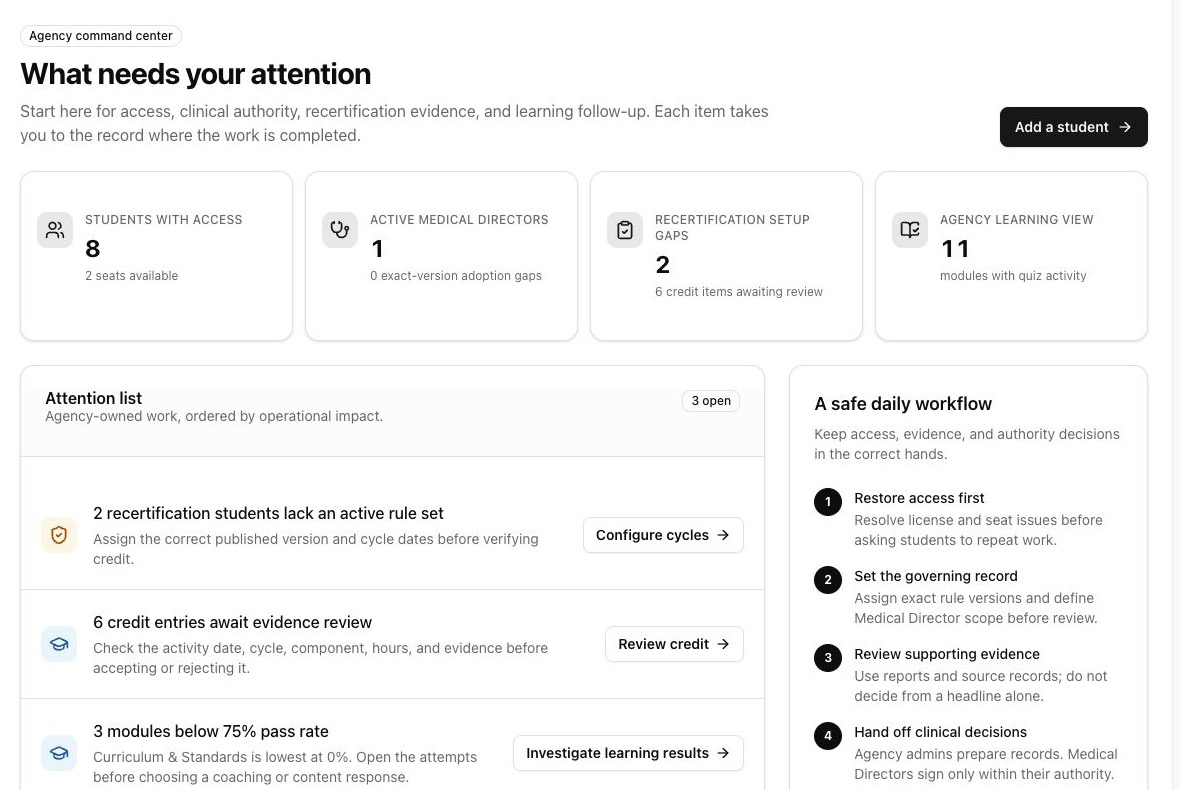
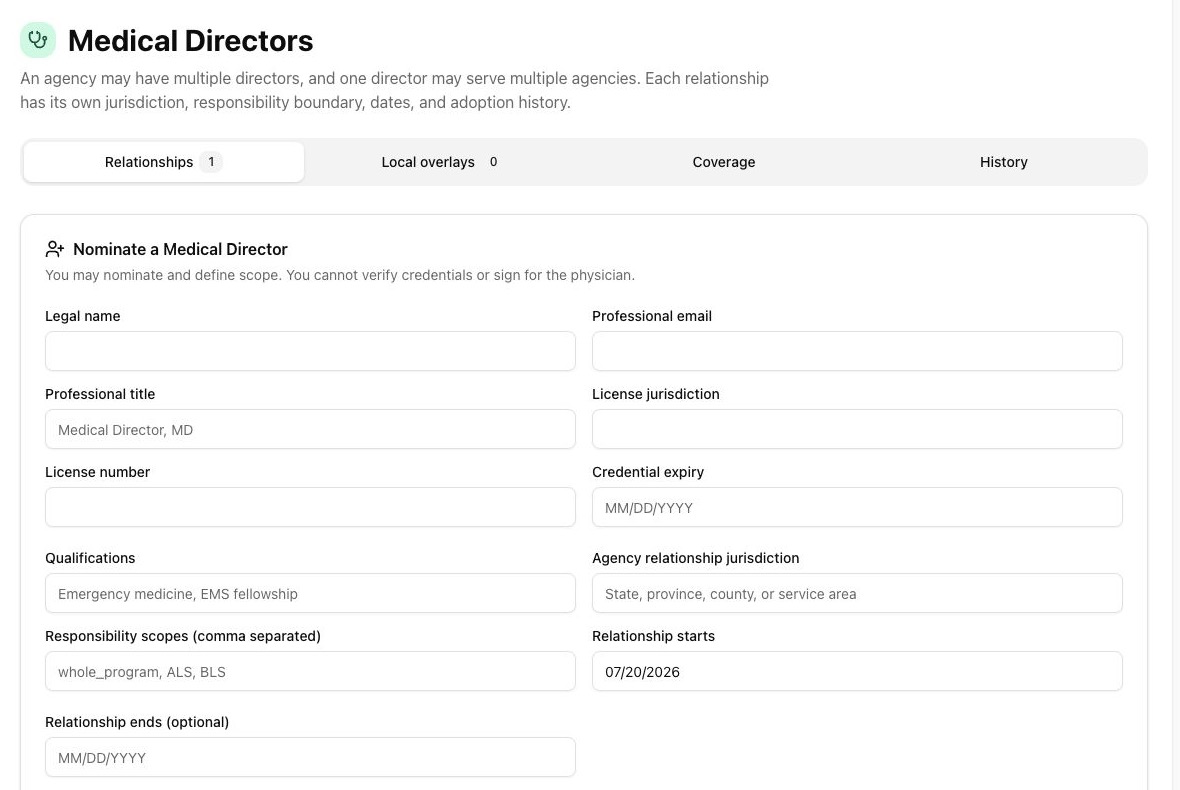
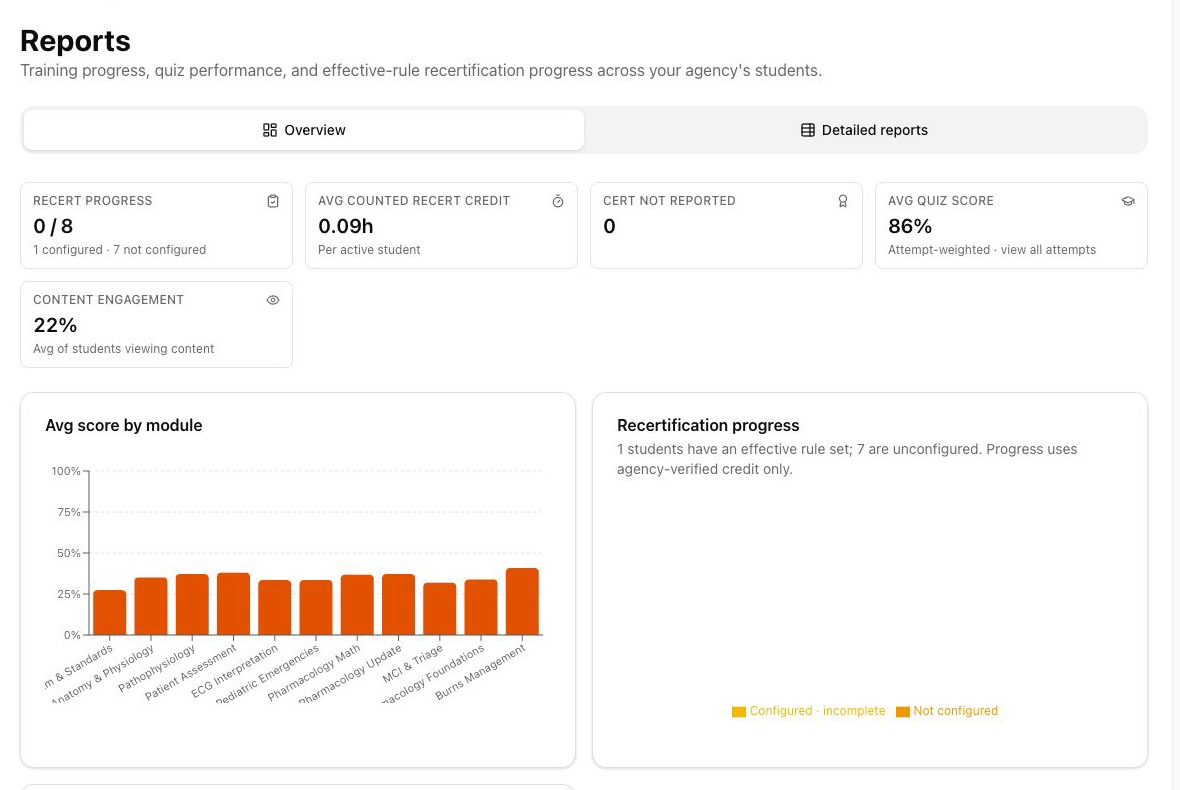
The agency dashboard starts with work that needs attention and links to the record where that work is completed.
Current release-candidate UI · synthetic demonstration data
Why hospital-based EMS programs use NTCP
- A single dashboard view of roster-wide certification and CME status for internal reporting
- Self-paced training that fits around clinical shift schedules
- Recert-deadline tracking that flags gaps before an audit finds them
- Seat-based licensing that scales with your program without per-provider procurement
The hospital-based angle
A hospital-affiliated EMS program sits in an odd spot organizationally: your providers are hospital employees, but their certification requirements come from the state EMS office and NREMT, not from anything in the hospital's own HR or credentialing system. That split is exactly the gap NTCP is built to sit in. It doesn't try to replace your hospital's credentialing or LMS platform — it's scoped narrowly to EMS certification-prep, recertification, and CME, and it gives your EMS coordinator or education office a roster-wide view that a general hospital system was never built to track at the level of individual EMS certification detail.
That narrow scope is a feature, not a limitation, when the question you actually get asked is "who on the EMS roster is current, and who's coming up on a recert deadline" — a question a hospital-wide HR system usually can't answer with any precision, because it isn't tracking NREMT cycles or state renewal windows in the first place.
What this covers
The platform is built around three pieces that work together rather than as separate products. Certification-prep training for EMT, AEMT, and Paramedic levels gives new hires and transferring providers a structured, self-paced path through the material. Recertification training covers the ongoing side — keeping already-certified providers current — and is built as genuinely separate content from initial certification-prep, not a re-skin of the same modules. And CME tracking lets providers log continuing-education hours against their own record as they complete them.
Two tools sit alongside that core training. The Full Practice Exam is a configurable 20/40/80-question exam-style practice assessment, with scoring computed server-side (so a result can't be faked from the browser) and a per-content-area breakdown showing which NTCP content areas a provider may need to revisit. It is not an official National Registry examination or certification-readiness prediction. The Drug Label Lookup is a one-drug label reference — not a static reference list — built on real RxNav (National Library of Medicine) and openFDA drug-label data, with around 20 quick-select common EMS drugs and dedicated sections for boxed warnings, interactions, and contraindications.
How it fits your existing dashboards
NTCP separates work across four roles. Your EMS education office or coordinator gets Agency Admin access — a roster-wide view of certification status, CME progress, and training completion across every provider licensed under your program. Individual providers get a Student dashboard scoped to their own training, practice exams, and CME log. A properly scoped Medical Director reviews exact clinical versions and local overlays for the agency. A platform-level Owner role manages NTCP policy, content, organizations, and launch controls.
Agency training records are primarily reviewed in the application. The Medical Director workspace can export decision-history and adoption-coverage tables as CSV, but NTCP does not currently claim a general ePCR connector, regulatory submission, or universal PDF reporting workflow. Confirm the exact downstream evidence and export needs during implementation.
What certification tracking is — and isn't
NTCP does not issue, verify, or guarantee NREMT or state EMS certification — that's the job of NREMT and your state's EMS office, and it stays that way regardless of how a provider's training or CME record looks inside NTCP. Certification level, license numbers, and expiry dates in the roster view are self-reported by each provider, not pulled from or cross-checked against the NREMT registry or your state's licensing database. Treat the dashboard as your program's own internal record-keeping — a clean, current view of where everyone stands — not an independent verification service standing in for NREMT or the state registry. The same applies to CME: the log is self-reported, and it is not currently CAPCE-accredited, so it documents hours completed rather than substituting for accredited-provider CME where your state requires it. For the authoritative rules on hours, fees, and renewal cycles in your jurisdiction, your state EMS office and state requirements resources are the reference, alongside our own certification and recertification and CME/CE overviews.
Licensing and getting started
NTCP is licensed per agency, not sold as an individual subscription — there's no direct public purchase path for a single provider. A hospital-based EMS program licenses a block of seats sized to its roster: 5 seats at $999/year or 10 seats at $1,799/year, covering certification-prep, recertification training, the practice exam, drug lookup tool, and CME log for everyone on that license. See Pricing for the full breakdown, or start the process directly at Sign Up Your Agency. If you want to see the mechanics before committing, How It Works walks through the student experience end to end, and Agency Training Management covers the admin side in more depth. Questions specific to your program's setup can go to Contact.
How this compares to other agency types
The core platform is the same regardless of agency type — the difference is context. Fire departments and EMS services tend to lean on the same roster-wide dashboard for shift-based training scheduling, while training programs use it more heavily on the initial certification-prep side, ahead of a student's first Registry attempt. Hospital-based programs typically sit in the middle — a mix of newly certified hires still in certification-prep and a larger base of already-certified staff cycling through recertification and CME — which is exactly the mix NTCP's roster view is built to show at a glance rather than as two disconnected lists.