

NTCP for Fire Departments
Most fire department personnel carry an EMS certification alongside their fire suppression duties — EMT, AEMT, or Paramedic, layered onto a Firefighter I/II or driver-engineer track that already has its own training calendar. NTCP is built for that half of the roster specifically: the EMS certification lifecycle, from initial cert-prep training through every recertification and CME cycle, tracked department-wide and drillable down to any individual crew member.
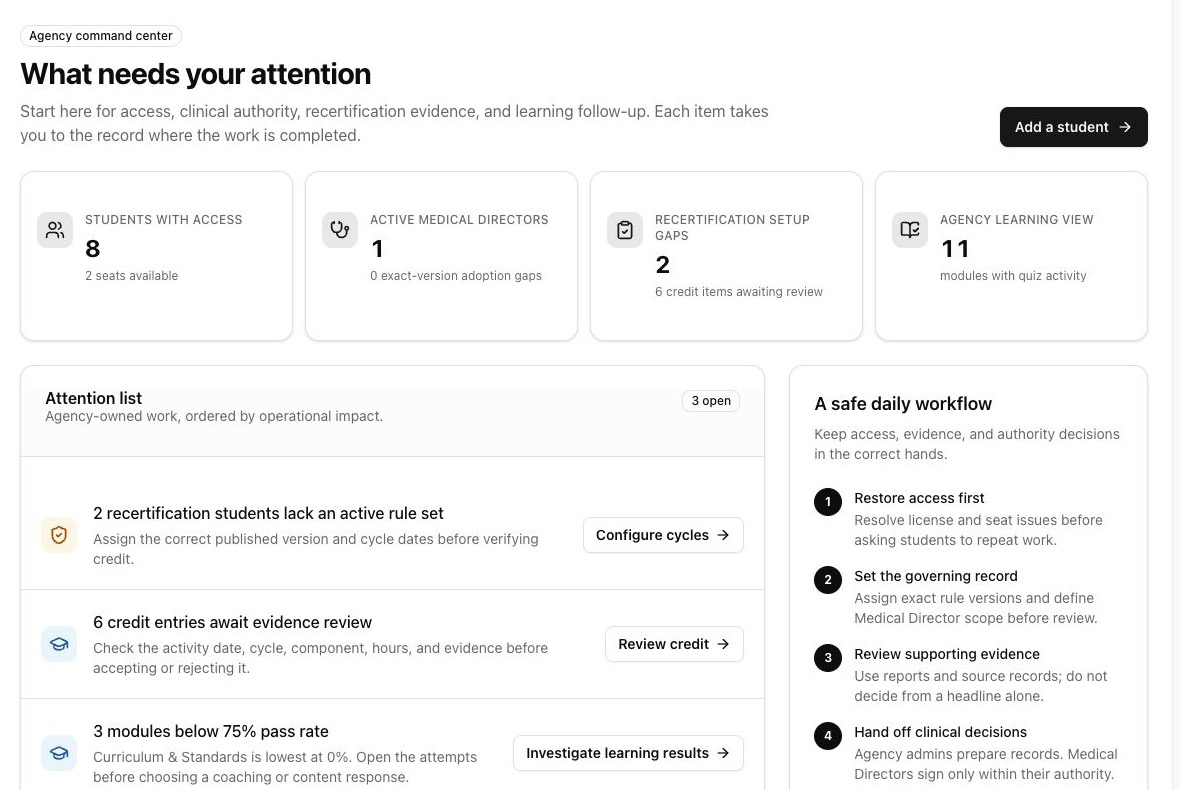
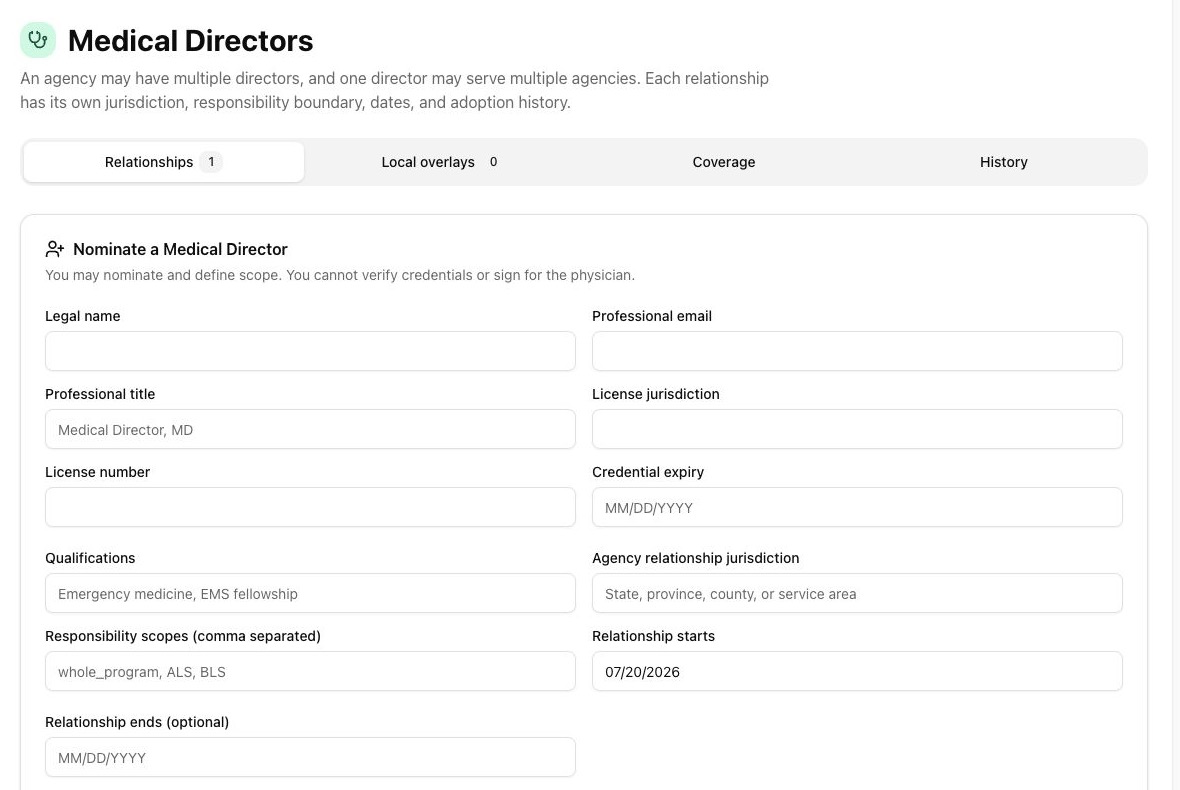
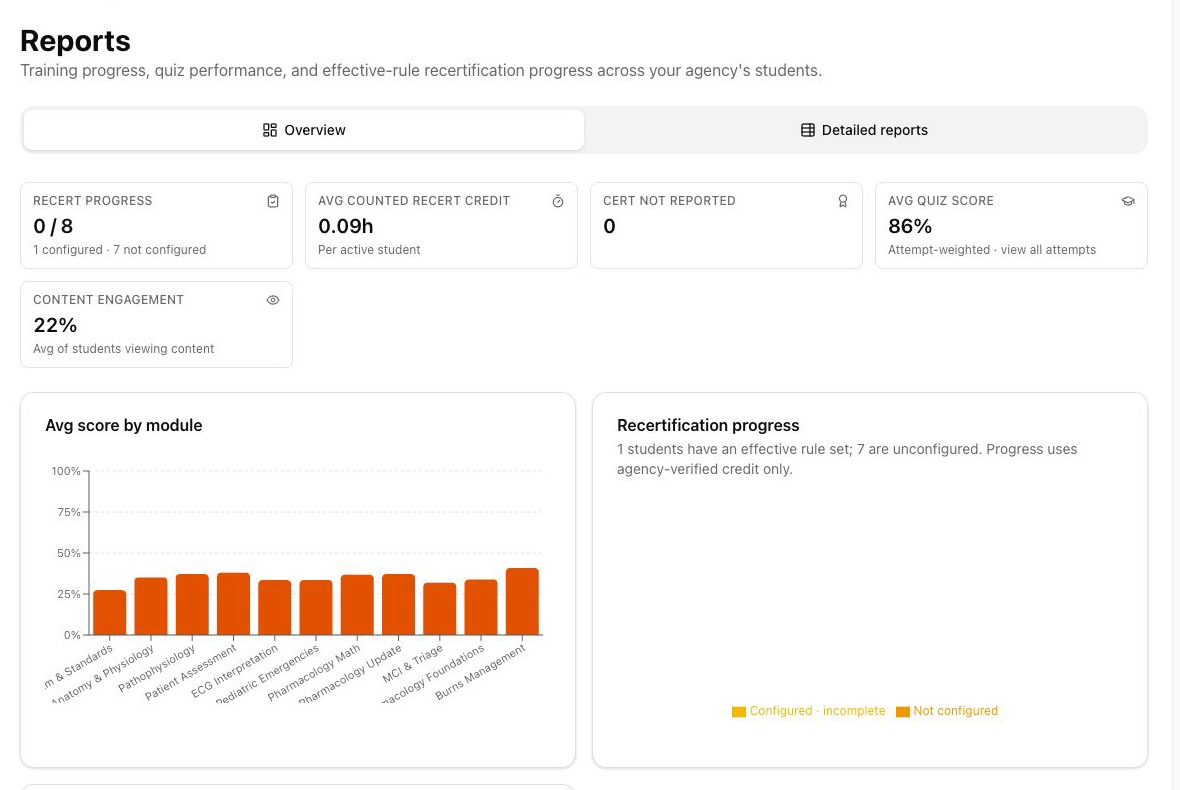
The agency dashboard starts with work that needs attention and links to the record where that work is completed.
Current release-candidate UI · synthetic demonstration data
Why fire departments use NTCP
- Track EMT/AEMT/Paramedic certification status across every shift, in one dashboard
- Onboard new hires' EMS credential tracking from day one
- Self-paced training modules crews can complete between calls, not just in a classroom
- See recert deadlines coming up department-wide before they become a compliance problem
- Keep the EMS side of dual-role personnel separate from fire-side training records
Dual-role personnel: two certification tracks, one roster
A firefighter/paramedic answers to two separate certifying paths — the fire service structure for firefighter certification, and the state EMS office (plus NREMT, in states that use NREMT for reciprocity and initial certification) for EMS certification. NTCP doesn't try to be a general fire-training-records system; it stays focused on the EMS side — certification level, recertification due dates, and CME hours logged toward that specific credential. Departments that already run a separate system for fire-side training keep using it. NTCP is the EMS-specific layer that sits alongside it, not a replacement for it.
Built around shift schedules, not classroom seats
Training-officer time and shift-coverage math don't leave much room for pulling a full crew off a rig for a classroom session. NTCP's training modules are self-paced and available whenever a crew member has downtime — between calls, during a slow overnight, or from home on an off shift. Progress saves automatically and resumes exactly where a student left off, so a module started at 2am on a 24-hour shift and finished three days later on the next rotation is still one continuous attempt, not a restart.
Roster-wide visibility for training officers
The Agency Admin dashboard is where a training officer or EMS coordinator sees the department-wide picture: every EMS-certified member's certification level, training progress, and recertification due date, in one view with drill-down to any individual. That's what turns "who's coming due for recert this quarter, and on which shift" from a question you dig for manually into something visible at a glance — before a lapsed recert turns into a shift-coverage gap.
Onboarding new hires and lateral transfers
A new hire arriving with an EMT or Paramedic certification from another state, or a lateral transfer between departments, gets their EMS credential tracking started in NTCP from day one — training progress, recertification clock, and CME log all begin where the platform can see them, rather than living in a folder that has to be manually reconciled later. That matters most in the first probationary period, when a training officer still needs to confirm a new member's certification is current and on the right recert schedule before they're cleared to ride the box independently — having that status visible on the roster from the first shift removes a manual check that's easy to let slip during a busy onboarding.
Certification-prep and recertification training
NTCP covers EMT, AEMT, and Paramedic certification-prep training, plus ongoing recertification training for members who are already certified and need to maintain it. Both run on the same self-paced module structure, so a member moving from initial cert-prep into their first recert cycle stays in one system rather than switching platforms partway through their career.
Practice exams and clinical reference tools
For members preparing for a National Registry certification examination or a state exam, the Full Practice Exam is a configurable 20/40/80-question exam-style practice assessment scored server-side with a per-content-area breakdown. It does not reproduce the official exam or predict certification results, but it can show which NTCP content area a candidate should review, not just a pass/fail number. Certified members can also use the Drug Label Lookup — a one-drug label reference using RxNav (NLM) and openFDA drug-label data, not a static reference sheet — to study available label interaction, contraindication, and boxed-warning sections. It is not a patient-specific clinical decision tool and does not replace agency-approved resources or Medical Direction.
CME tracking
CME Tracking lets certified members enter outside education evidence for agency review. NTCP is not currently a CAPCE-accredited CE provider, so the internal record does not substitute for accredited or externally accepted CE where your state specifically requires it. See What Is CAPCE Accreditation? for the distinction.
What NTCP doesn't do
NTCP does not issue or guarantee NREMT or state EMS certification — that determination stays with NREMT and your state EMS office; NTCP's job is to prepare and track, not certify. NTCP does not claim a production ePCR or records-management integration. Agency operational reports are reviewed in the product; the Medical Director workspace has a limited CSV export for decision and coverage tables, not a replacement for the governed signed record. If your department needs certification specifics for your state — required hours, renewal cycles, fees — your state EMS office or NREMT.gov is the authoritative source; see our State Requirements pages for what we've already documented.
Licensing and pricing
NTCP is licensed per agency, not sold as an individual subscription — seats cover your whole EMS-certified roster under one department license, with role-based Owner and Agency Admin dashboards for whoever manages it. Current tiers are 5 seats at $999/year and 10 seats at $1,799/year; see Pricing for the full breakdown, or how the admin side works on Agency Training Management.
How the four roles divide the work
NTCP splits by role rather than giving everyone the same screen. NTCP's platform Owner manages platform policy, organizations, billing, and launch controls. Your department's training officers and EMS coordinators work from the Agency Admin workspace for seats and the roster-wide training view. A separately authorized Medical Director reviews exact clinical versions and local overlays within the recorded agency scope. Individual crew members get the Student workspace: their own modules, practice assessments, Drug Label Lookup, and CME log, without visibility into the rest of the roster.
Related pages
Compare the fit for other agency types on For EMS Services, For Hospital-Based EMS, and For Training Programs — or start with How It Works for the platform overview end to end.